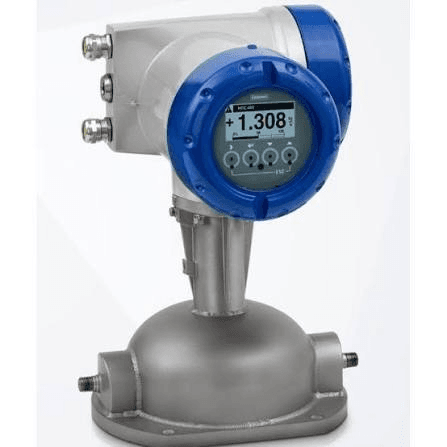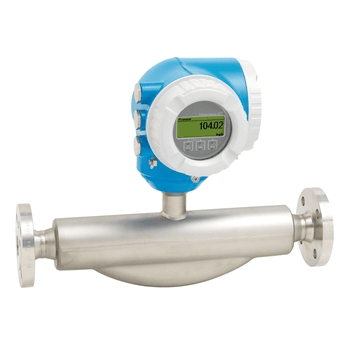
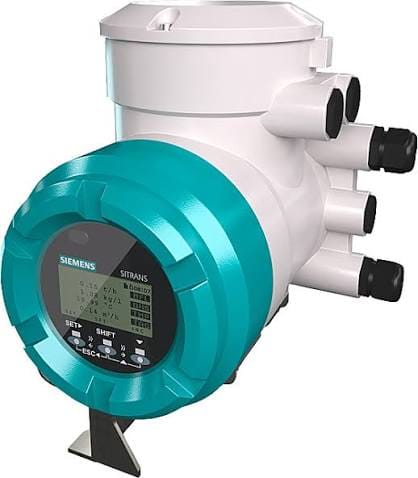
Product Overview
The Siemens SITRANS FC represents a milestone shift in industrial mass flow instrumentation, engineered specifically to address heavy acoustic noise and high-vibration boundaries common to marine bunkering manifests. By rewriting traditional architecture limits, this system ensures accurate data validation where erratic pipeline process flows traditionally introduce tracking errors.
::callout{icon="i-lucide-radio" color="primary"} Early Stage Digitization: Unlike legacy flowmeters that route weak analog curves over long cables, the SITRANS FC captures raw microvolt oscillations and sanitizes them directly inside the Digital Sensor Link (DSL) module right at the physical boundary. This produces an optimized signal-to-noise ratio that is immune to surrounding engine room electromagnetic noise. ::
Non-Technical Overview: Value Proposition
- Supreme Fuel Auditing Accuracy: Purpose-built to measure heavy fuel oils (HFO) precisely as they move into vessel containment grids, protecting operators from financial disputes.
- Handles Entrained Air Content: Avoids measurement drops from line churning or air pockets during pipeline scraping operations via its built-in Aerated Flow Filtering software.
- Instant, Plug-and-Play Servicing: The onboard SensorFlash module retains all calibration logs, structural assets, and certificates. If a transmitter head needs replacement, swapping the SD-card copies over settings automatically without setup software.
- Blazing Fast System Diagnostics: Runs on a 100 Hz high-speed refresh rate, recording system alterations within milliseconds to protect rapid batch dosing control systems.
Technical Deep-Dive: Processing Architecture
At a lower architecture layer, the platform combines custom Coriolis twin-tube elements with the PrecisionPLUS™ computing algorithm. The system calculates three core process measurements concurrently mass flow, density, and medium temperature and extrapolates secondary values like fractional volume or brix percent directly inside the local computing logic. This minimizes the reliance on separate host computers.
Architecture Specification Grid
Utilize the tabs below to verify core interface boundaries and hardware constraints.
| Metrology Feature | Base Performance Values |
|---|---|
| Signal Conversion Core | Localized Digital Sensor Link (DSL) analog-to-digital layer |
| Mass Flow Tracking Accuracy | ±0.10% standard deviation across variable media profiles |
| Density Tracking Accuracy | Precise to a tight limit of ±0.5 kg/m³ |
| Core Refresh Loop Speed | 100 Hz lightning-fast operational scanning cycle |
| Process Parameter | Boundary Range Metric |
|---|---|
| Nominal Cross-Sections | Available from DN 15 up to DN 150 flanged options |
| Standard Delivery Range | Scale variants handling volumes between 1,600 and 170,000 kg/h |
| Multi-Phase Optimization | Real-time mitigation vectors for fluid lines holding air pockets |
| Media Suitability | High-viscosity marine fuel loops, dynamic chemical mixtures, and gas arrays |
| Bus Interface Element | Engineering Parameters |
|---|---|
| HMI Control Setup | Advanced graphical screen featuring local 4-button optical touch glass |
| On-Board Diagnostics | Internal system tracking runs self-verification without opening pipe lines |
| Primary Channel Data Bus | Standard configurations support Modbus RS485, PROFINET, HART, or PROFIBUS |
| Memory Storage Lifespan | SensorFlash micro-SD architecture tracking all events and device copies |
Core Deployments & Use Cases
Marine Fuel Bunkering
Ensures absolute tracking accuracy and custody protection on fuel barges, dock networks, and ocean-going merchant fleets handling heavy fuel loops.
Multi-Phase Slurry Loops
Maintains continuous logging accuracy during aggressive industrial fluid processing even when micro-bubbles, air voids, or gas slugs pass through the meter.